
26 Best AI Marketing Tools in 2026, Compared
By Jordan Patel, Tech Analyst · Updated
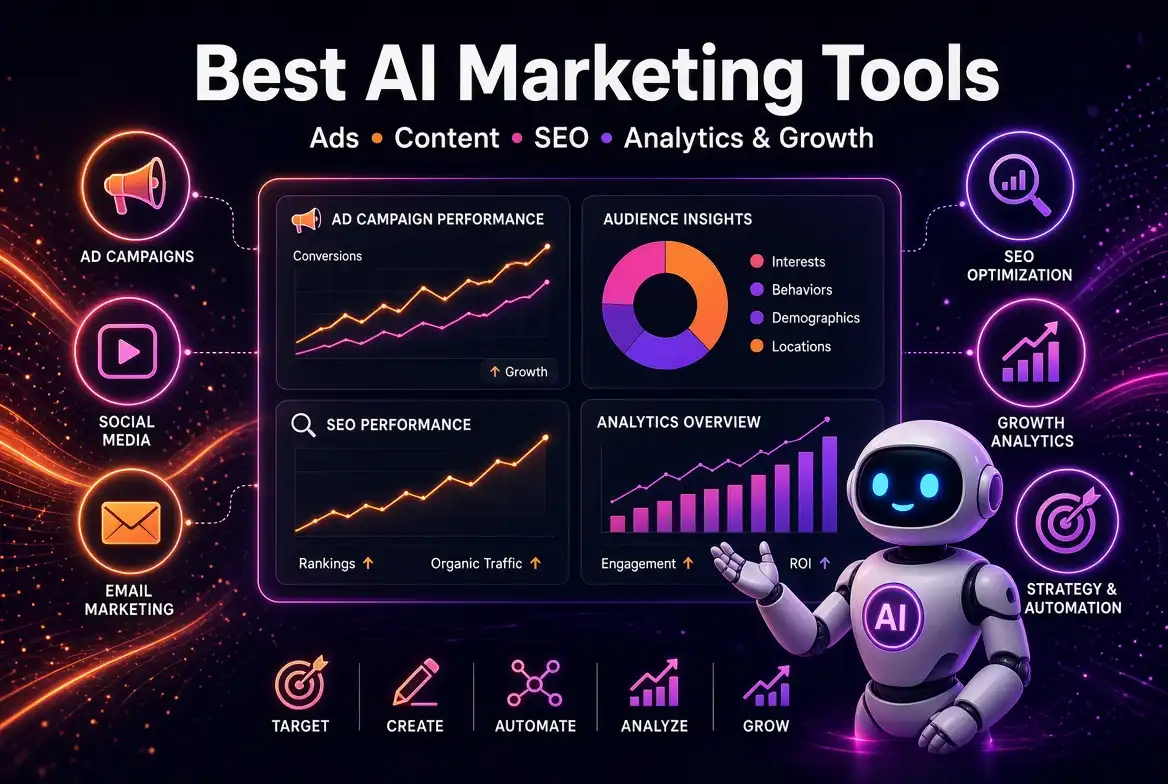
Short answer: the best AI marketing tools in 2026 cover seven jobs: content, SEO, social media, ads, email outreach, automation and visuals. A practical starter stack is ChatGPT or Claude for drafts, Jasper for brand copy, Surfer SEO for search, Buffer for social posts and Canva for visuals. Below are 26 AI marketing tools side by side, with prices as listed on each tool's page.
Quick comparison of the best AI marketing tools
Numbers show list order inside each job, not a score. Confirm prices on the vendor site before you pay.
| Tool | Best for | Starting price | Watch out for |
|---|---|---|---|
| ChatGPT | Campaign ideas, copy drafts and research | Free plan, from $20/mo | Free tier shows ads in the US |
| Claude | Long-form drafts and brand-voice rewrites | Free plan, from $20/mo | No native image generation |
| Jasper | Marketing teams that need a brand voice | Paid, from $39/mo | No free plan, pricier than budget writers |
| Copy.ai | Sales and go-to-market workflows | Paid, from $29/mo | Free plan retired, paid from day one |
| Writesonic | SEO content plus AI search tracking | Paid, from $79/mo | Pricing is about 5 times its earlier entry point |
| Grammarly | Polishing tone and clarity in any app | Free plan, from $12/mo | AI prompt caps are where free and Pro differ |
| Surfer SEO | Scoring drafts against live search results | $49/mo, yearly | No technical SEO or backlink data |
| Semrush | All-in-one SEO and AI visibility | $139.95/mo | The Pro plan caps at 5 projects |
| Buffer AI Assistant | Scheduling with free AI drafting on every plan | Free plan, from $6/mo per channel | Per-channel billing adds up for many accounts |
| Hootsuite OwlyWriter | Enterprise social teams that want trend-aware captions | Paid, from $99/mo | No free plan, only a 30-day trial |
| Later | Visual-first Instagram scheduling | Free plan, from $25/mo | Priced per social set, so it can cost more per post |
| Ocoya | Designing and scheduling posts in one tool | Paid, from $15/mo | A shared credit pool runs out faster with heavy use |
| Predis.ai | Complete visual posts from one prompt | Free plan, from $19/mo | Credits must be tracked across content types |
| OpusClip | Cutting long videos into short clips | Free plan, from $15/mo | Clip picks still need your review |
| Taplio | LinkedIn growth for B2B marketers | Paid, from $32/mo | LinkedIn only |
| AdCreative.ai | Ad creatives at volume with conversion scoring | Paid, from $20/mo | Video creative needs the $249/mo tier |
| Pencil | AI ad creative generation | Paid, from $14/mo | 50 monthly generations are tight for heavy testing |
| Madgicx | Daily recommendations for Meta ad accounts | Free plan, from $44/mo | Meta-only for managed ads |
| Persado | Testing which words and tone convert | Free trial | Enterprise-quoted pricing with no self-serve option |
| Smartly.io | Enterprise ad automation across Meta, TikTok and Google | Free trial | No published pricing or self-serve signup |
| Lavender | Scoring cold emails before you send | Free plan, from $29/mo | Coaches email writing only |
| SmartWriter | Researched, personalized cold outreach | Paid, from $59/mo | Does not send emails, so you need a sending tool |
| HubSpot Breeze | AI agents and a copilot inside the HubSpot CRM | Free plan, from $20/mo | Only valuable if you use HubSpot |
| n8n | Open-source workflow automation | Free plan, from $20/mo | Self-hosting needs real technical setup |
| Canva | Social graphics and ad visuals | Free plan, from $15/mo | Pro rose from $12.99 to about $15/mo |
| HeyGen | AI avatar videos for marketing | Free plan, from $29/mo | Premium avatars cost far more than the headline price |
All 26 tools
ChatGPT
Trending FeaturedOpenAI's flagship assistant, now running on the GPT-5.6 model family
ChatGPT remains the AI chatbot most people mean when they say "AI" — helping with writing, coding, research, brainstorming, image generation and voice conversation, used by hundreds of millions of people weekly. Its underlying model has moved well past the GPT-4o generation many older reviews still describe: as of July 9, 2026, ChatGPT runs on the GPT-5.6 family, with three named tiers — Sol (frontier reasoning), Terra (balanced) and Luna (fast, budget) — rather than a single flagship model. The subscription lineup expanded meaningfully too. Free now gives unlimited text chat on GPT-5.6 Luna (with ads in the US, rolling out from August 2026) alongside capped image, voice and file uploads. A new Go tier at $8/month, launched globally in January 2026, raises those caps without unlocking Agent mode or Deep Research. Plus stays at its familiar $20/month, now including the full GPT-5.6 family, Agent mode, and a mix of full and lightweight Deep Research tasks. Pro splits into two usage-based tiers — $100/month (5x Plus usage) and $200/month (20x Plus usage, largest limits, priority compute) — closing the old 10x jump from $20 straight to $200. Business and Enterprise remain built for organizations, with Business running roughly $20-25/seat/month (2-seat minimum) and Enterprise custom-quoted, commonly cited in the $45-75/seat/month range for large deployments with SSO, dedicated data residency and compliance paperwork. For most individual users doing regular work, Plus at $20/month remains the practical sweet spot; light or occasional users can now genuinely get by on the improved Free tier, and heavy professional users have a real $100 middle ground before jumping to the top Pro tier.
Claude
Trending FeaturedAnthropic's assistant, now on the Sonnet 5 and Opus 5 generation
Claude remains known for nuanced reasoning, careful writing and strong coding performance, built by Anthropic around a Constitutional AI safety approach. The model lineup has moved well past the 200K-context generation many older descriptions still reference: current models include Claude Sonnet 5 (released June 30, 2026) and Claude Opus 5 (released July 24, 2026), both supporting up to a 1-million-token context window on qualifying plans — a meaningful jump for anyone working with large documents or codebases. Subscription tiers now include Free, Pro at $20/month (the familiar entry point, includes Claude Code), and two Max tiers — $100/month (5x Pro usage) and $200/month (20x Pro usage) — for people who exhaust Pro's session and weekly limits regularly. Pro, Max and Team plans share a session limit (resets every five hours) plus a weekly limit across all models, with both pools shared between the Claude apps and Claude Code specifically. On the API side, current per-million-token rates run Haiku 4.5 at $1/$5 (input/output), Sonnet 5 at $2/$10, and Opus 5 at $5/$25 — Opus notably cheaper than the prior Opus 4.8 generation. Claude Code's rapid growth (reportedly $2.5 billion in annualized revenue) reflects how central coding has become to Claude's use case, and Anthropic closed a $30 billion Series G funding round in February 2026 at a $380 billion valuation, with a potential IPO discussed as early as October 2026. For most individual users, Pro at $20/month remains the right starting point; developers and teams doing sustained heavy coding work are the ones who typically outgrow it into Max.
Jasper
Enterprise-focused AI content platform for marketing teams
Jasper remains one of the more established AI writing platforms specifically built for marketing teams and enterprises, offering brand voice consistency, campaign-level content generation, and workflow tools for coordinating content across a team rather than just single-document drafting. Its Brand Voice feature lets an organization train the AI on existing content to maintain consistent tone and messaging across every piece of copy generated, a genuine differentiator from general-purpose writing tools for larger marketing operations. Pricing runs Creator around $39-49/month for individuals, Pro/Teams around $59-69/month per seat with collaboration features, and custom Business/Enterprise pricing for larger organizations needing SSO, API access and dedicated support — broadly consistent with prior pricing, without the dramatic restructuring seen in some other categories. Jasper has continued building out campaign-management and workflow features (content briefs, approval flows, integrated SEO guidance) that position it more as marketing infrastructure than a standalone writing assistant. For solo creators or bloggers, Jasper's pricing and enterprise-oriented feature set is often more than what's needed — cheaper, more focused tools like Rytr or Copy.ai frequently deliver comparable value for individual use at a lower cost. Jasper's real strength remains marketing teams needing brand consistency, collaborative workflows and campaign coordination across multiple content creators simultaneously.
Copy.ai
AI go-to-market automation platform for sales and marketing teams
Copy.ai started as a straightforward AI copywriting tool but has repositioned firmly toward go-to-market automation: its Workflows feature chains multiple AI tasks into pipelines — scrape a URL, summarize it, generate personalized outreach, push the result into Salesforce or HubSpot — turning it into revenue-team infrastructure rather than a simple writing assistant. Short-form copy (ad copy, email subject lines, social captions across 90+ templates) is still solid, but the writing itself has genuinely taken a back seat to automation in how the product is built and priced. That shift shows clearly in pricing: as of 2026, Copy.ai's free plan (which once offered meaningful usage) has been retired for the core platform — some standalone tools like a paraphraser or hook generator remain free, but the base platform requires a paid plan from day one, generally cited between $29-49/month depending on source and promotional period. Paid tiers scale by seats and Workflow credits rather than word count, with SOC 2 Type II, GDPR, SSO and SCIM available for larger teams running automation at scale. It's genuinely strong specifically for B2B sales and marketing teams that will build and run many Workflows connecting AI directly to CRM tools — the premium pricing reflects real automation capability, not just branding. For freelancers, solo bloggers, or anyone mainly wanting SEO-optimized long-form content, the price feels heavy relative to Writesonic or Jasper, which lean more directly into content creation rather than sales-workflow automation.
Writesonic
AI search visibility platform: content, SEO and GEO tracking combined
Writesonic has undergone one of the more dramatic repositionings in this category: it started as a general-purpose AI writer and, through 2024-2025, rebuilt itself into an AI search visibility platform that combines long-form content generation, traditional SEO tooling, and Generative Engine Optimization (GEO) tracking across ChatGPT, Gemini, Perplexity and Google AI Overviews in one product. Its Article Writer holds coherent structure through 1,500-2,000 words better than most competitors at a comparable price, and Chatsonic adds live web browsing for research grounded in current information rather than training-data knowledge alone. That repositioning shows clearly in price: what many older reviews still describe as a roughly $16/month tool is now a fundamentally different, considerably pricier platform, with Starter at $79/month (annual billing) tracking 50 AI prompts across ChatGPT/Gemini/Google AI Overviews, writing 15 articles and running 10 SEO audits monthly, scaling to Basic ($199/month) and Growth ($399/month) for higher volume and more comprehensive tracking. If a review or comparison you're reading quotes $16/month, it's describing outdated pricing from before this platform shift. The combined SEO-plus-GEO-plus-content-generation approach reduces genuine tool sprawl for teams that would otherwise pay separately for a writer, an SEO platform and a citation tracker — that's a real, differentiated value proposition as AI search increasingly matters alongside traditional Google rankings. For a solo blogger or small team not yet prioritizing AI-search visibility specifically, the jump from around $16 to $79/month is a lot to justify versus a narrower, cheaper tool like Frase or NeuronWriter.
Grammarly
TrendingSimplified into one Pro tier in 2026 — but AI prompt caps are where it bites
Grammarly remains the most widely adopted AI writing assistant, checking grammar, spelling, tone and clarity across virtually every app and browser via its extension, desktop app and integrations. Its 2026 pricing genuinely got simpler on paper: the old separate Premium and Business plans folded into a single Pro tier, so any older article describing those legacy plans no longer reflects current offerings — there are now just three tiers: Free, Pro, and Enterprise. Pro runs $12/month on annual billing (or $30/month paid monthly) and bundles grammar checking, AI rewriting, plagiarism detection, AI text detection, fluency suggestions, style guides, brand tones, snippets and team analytics — genuinely comprehensive for the price. The catch worth understanding before upgrading: the meaningful gap between Free and Pro isn't really about grammar-checking depth, it's AI prompts specifically — Free includes 100 AI prompts/month while Pro jumps to 2,000, and daily AI-heavy users report this cap is where the free plan actually becomes limiting, not the core proofreading itself. Review sentiment is notably split by platform: strong 4.7/5 scores on both G2 (12,969 reviews) and Capterra (7,210 reviews), but a more mixed 3.5/5 on Trustpilot from 10,394 consumer reviews — reflecting real frustration some users report around billing surprises and strict refund terms, worth reading before committing to annual billing. For daily writers, users consistently describe Pro as paying for itself in time saved on editing and tone adjustment compared to hiring an editor or stacking multiple narrower tools; occasional users may find the free tier's 100 monthly AI prompts genuinely sufficient without ever needing to upgrade.
Surfer SEO
Content optimization scoring against real-time SERP data
Surfer SEO remains a leading content-optimization platform, scoring your draft against the actual top-ranking pages for a target keyword and suggesting specific terms, structure and length adjustments to improve topical relevance. Its Content Editor gives real-time scoring as you write, and its Audit tool evaluates existing published content against current SERP data to identify what's holding a page back from ranking higher. Pricing has moved modestly upward, now running roughly $89-99/month for the entry Essential tier (close to but slightly above the previously cited $89), with Scale and Scale AI tiers above that adding more articles, team seats and AI-assisted drafting. Surfer remains part of the broader Surfer Group alongside NeuronWriter (a more budget-focused sibling product covering similar ground at a fraction of the price), giving the company coverage across both premium and budget segments of the content-optimization category. For content teams and agencies where SEO performance directly drives revenue, Surfer's data-driven scoring against real-time SERP data remains a strong, trusted tool. For solo bloggers or budget-conscious teams, its sibling product NeuronWriter or a competitor like Frase typically delivers a large share of the same core value at a meaningfully lower price point.
Semrush Copilot
TrendingA free AI assistant layered onto the largest all-in-one SEO platform
Semrush Copilot is a free AI assistant included on every paid Semrush plan, analyzing data across the platform's core tools — site audits, keyword tracking, backlink analytics — to surface personalized recommendations without an additional charge. It sits inside a much larger 50+ tool suite covering SEO, PPC, content marketing, social and competitive research, which is Semrush's core differentiator from narrower, SEO-only competitors like Ahrefs: one platform and one bill covering a genuinely broader marketing workflow. Beyond Copilot itself, Semrush's AI layer includes ContentShake AI for automated content creation and an AI Visibility Toolkit tracking brand presence specifically across ChatGPT and Google AI Overviews — priced as a separate add-on at $99-199/month depending on the source and package, notably positioned as roughly half the price of Ahrefs's comparable Brand Radar add-on ($199/month) according to several 2026 comparisons, though exact figures vary and are worth confirming directly given how frequently both companies adjust tiering. Base pricing runs Free (limited), Pro at $139.95/month (3,000 daily reports, 5 projects, Copilot included at no extra cost), Guru at $249.95/month (unlocks the Content Marketing Platform and Historical Data), Business at $499.95/month, and custom Enterprise. The 5-project cap on Pro is a common early friction point — freelancers managing several client sites hit it quickly and must choose between upgrading to Guru's 15 projects or losing historical tracking data by cycling projects. Direct MCP integration with Claude lets you automate site audits, keyword research and content strategy generation in a single connected workflow. For teams that want SEO, PPC, content and AI-visibility tracking under one platform and bill, Semrush's breadth is the clear draw; for teams wanting the cheapest entry point or the cleanest raw backlink data specifically, Ahrefs is frequently cited as the stronger, if narrower, alternative.
Buffer AI Assistant
Free AI drafting on every plan, now priced per social channel
Buffer's AI Assistant stands out for one specific reason: it's included on every plan, including the permanently free one, with no usage cap on how many posts or ideas you can generate — brainstorm content, repurpose existing material, and draft posts without worrying about running out of credits, a genuinely different model from competitors that gate AI behind a paid tier. That makes Buffer the most accessible entry point for solo creators or small teams wanting AI-assisted social content without committing to a subscription first. A meaningful pricing shift worth understanding: Buffer now charges per social channel rather than one flat monthly fee for a fixed bundle of accounts. The Essentials plan starts around $6/month per channel, with a Team tier around $12/month per channel adding collaboration tools and deeper analytics — a creator managing five channels lands around $25-30/month total, a notably different math than a single flat subscription price implies at first glance. The free plan covers three channels with 10 queued posts each, permanently, with no credit card required. Beyond AI drafting, Buffer's newer API enables custom AI workflows — connecting external tools like ChatGPT or Claude to draft, schedule and manage content through automations rather than relying solely on Buffer's built-in assistant. For teams needing more than three channels or wanting deeper AI features like campaign idea generation and trend-based repurposing, Hootsuite's OwlyWriter offers a more feature-rich (but pricier and channel-count-limited-differently) alternative; for solo creators and small teams prioritizing simplicity and a genuinely free entry point, Buffer remains the easiest starting point in the category.
Hootsuite OwlyWriter
Enterprise social AI with trend-aware captions — no free plan
OwlyWriter AI is Hootsuite's built-in content generation engine, producing platform-optimized captions, campaign ideas and repurposed versions of top-performing past posts, with social listening integration meaning captions can reflect real-time trending topics rather than working from a static prompt alone. It's positioned for genuinely enterprise-scale social operations — multi-platform scheduling, team approval workflows, and integration with Grammarly and Proofpoint for regulated-industry compliance review. A structural change worth knowing: Hootsuite discontinued its free plan back in 2023, and the platform underwent a broader pricing re-tier in 2026, moving to four tiers (Standard, Professional, Advanced, Enterprise) billed per user per month rather than the older single-tier-plus-add-ons model. Standard runs $99/user/month (billed annually) for 10 social accounts and includes OwlyWriter AI at every paid tier; Advanced is $149/user/month for unlimited accounts and bulk scheduling up to 350 posts; Enterprise requires 5+ users and 50+ accounts with custom pricing. Deeper social listening through Talkwalker specifically requires the Business tier at $739/month or higher — a genuinely steep jump if trend monitoring is a priority. The "seat tax" is worth budgeting for directly: each additional team member costs another full $99+/month, since Hootsuite bills per user rather than per account — a small team of three users on Standard runs $297/month before any add-ons. For small teams needing just scheduling and basic AI captions, that pricing is genuinely difficult to justify against lighter-weight alternatives like Buffer; OwlyWriter's real value case is for larger organizations that need its deeper AI content-idea generation, compliance integrations and enterprise governance at scale.
Later
Visual-first Instagram scheduling — the premium price is per social set, not per platform
Later built its reputation around visual content planning specifically: drag-and-drop posts onto a calendar, preview exactly how your Instagram grid will look before anything publishes, and schedule across Instagram, TikTok, Facebook, Pinterest, LinkedIn, X and YouTube Shorts from one dashboard. For brands and creators whose strategy is genuinely Instagram-first — where grid aesthetics matter as much as caption copy — that pre-publish visual preview remains a real differentiator most competitors don't replicate as thoroughly. Pricing runs on a "social set" model rather than per-channel or per-post: one social set covers one profile per platform, and Starter at $25/month (or $18.75/month billed annually) includes just one social set, one user, and a 30-post-per-profile monthly cap — restrictive enough that many small teams outgrow it within a few months and face jumping straight to Growth at roughly double the price ($50/month, or $37.50 annually) for three social sets, three users and 150 posts per profile. A Free plan exists but Later's own documentation doesn't publish one universal post-count limit for it, making it more of a genuine trial than a sustainable long-term free tier. Compared per-post specifically, Later runs pricier than Buffer's per-channel model ($5-6/month per channel, unlimited posts) or Publer's flat unlimited scheduling ($12/month) — the premium buys the visual grid-planning workflow and link-in-bio monetization tools bundled in, not raw scheduling volume. AI features (caption suggestions, content ideas from a prompt) are included on paid tiers but generate content from a prompt rather than analyzing your existing brand voice automatically. For a genuinely Instagram-grid-focused creator or small brand, the visual planning workflow justifies the premium; for teams prioritizing raw posting volume or multi-channel breadth over visual preview, a per-channel competitor will likely deliver more value per dollar.
Ocoya
Design and scheduling combined — Canva-style editor plus AI captions in one credit pool
Ocoya bundles a Canva-style visual design editor directly into its scheduling platform, aimed at solo creators and small businesses who want to design a post's actual visual and write its caption without switching between a separate design tool and a separate scheduler — a genuine workflow consolidation for anyone whose current process involves designing in Canva, exporting, then re-uploading into a scheduling tool. AI handles caption generation, hashtag suggestions and basic image generation within the same credit-metered system. Billing runs on a shared credit pool covering both AI generations and design exports, which is worth understanding before committing: heavy design + AI usage in the same month can exhaust your allowance faster than a pure-scheduling tool with unlimited posts would, since every AI caption and every exported design draws from the same pool rather than being billed separately or unlimited. Bronze, the entry paid tier, runs around $15-19/month depending on the source and billing period. There's no free plan — only a 7-day trial — which is a real consideration if you want to test the design-plus-scheduling combination before paying anything. For creators and small businesses who specifically want design and scheduling consolidated into one tool and one bill, rather than paying for Canva and a scheduler separately, Ocoya's combined workflow is a genuine time-saver; for anyone already happy with a separate design tool, the credit-sharing structure may feel more restrictive than a dedicated scheduler with unlimited posting.
Predis.ai
Generate complete visual posts — carousels, videos, ad creatives — from one prompt
Predis.ai's specific niche is visual-first content generation: rather than producing text captions you then need to pair with a separately-designed image, it generates complete posts — carousels, short-form videos and ad creatives — directly from a single prompt or uploaded product image, combining what would otherwise require ChatGPT plus Canva plus a scheduler into one workflow. It's a strong fit specifically for ecommerce and DTC brands and agencies needing volume visual content without involving a dedicated designer for every post. Usage is metered in credits rather than a flat post count, which is worth understanding upfront: a social image post costs 20 credits, a standard video runs 3 credits per 10 seconds, and a UGC-style AI-avatar video costs 10 credits per 10 seconds. A free tier lets you test the platform before committing, with paid plans starting around $19-29/month (Core, sources vary slightly by billing period) scaling to Rise ($40.79/month, 3,200 credits, up to 4 brands) and Enterprise+ (up to $249/month, 10,000 credits, unlimited brands, faster generation). AI-generated content is licensed for commercial use, including video exports in full HD 1080p, which matters for agencies running client ad campaigns. The honest limitation consistently noted across reviews: generated visuals often need brand polish or manual editing before they're truly publish-ready — Predis handles the heavy lifting of assembling a complete post fast, but rarely produces something requiring zero touch-up. For teams whose bottleneck is visual content specifically (not just captions), it fills a gap that text-focused competitors like Postwise or Buffer's AI Assistant don't address.
OpusClip
TrendingTurn long videos into ranked short-form clips automatically
OpusClip ingests a long video — a podcast, webinar, livestream or YouTube upload — and returns a set of vertical shorts cut at the moments most likely to perform. Its ClipAnything model analyses speech, visuals and pacing to find self-contained hooks rather than slicing on fixed intervals. Each clip arrives with animated captions, an AI-chosen title and description, reframed active-speaker tracking that keeps faces centred in 9:16, and a virality score explaining why the segment was picked. B-roll insertion and brand templates let you keep a consistent look across a channel. Teams publishing daily shorts use OpusClip to compress an editor's afternoon into a few minutes, then schedule the results straight to TikTok, Reels, Shorts and LinkedIn from the same dashboard.
Taplio
The LinkedIn-only growth tool, built by Tweet Hunter's team
Taplio applies the same specialized-growth-tool philosophy as its sister product Tweet Hunter, but focused entirely on LinkedIn: AI-powered post generation, a library of viral post inspiration to model structure from, scheduling, and lead-tracking features aimed specifically at B2B operators, founders and consultants building a professional audience and pipeline through LinkedIn content. Being built by the same team behind Tweet Hunter gives it a similar product philosophy — specialized depth on one platform rather than broad multi-platform coverage. Published pricing runs Standard from around $32-39/month, Pro from $55/month, and Teams from $149/month, positioning it in the same tier as Postwise but focused entirely on LinkedIn's specific content patterns (longer-form posts, professional tone, engagement-bait structures that work on that platform specifically) rather than X's shorter, faster-paced format. Lead-tracking functionality is a genuine differentiator from pure content-scheduling competitors — connecting LinkedIn engagement directly to pipeline visibility for B2B sales and consulting use cases. Its scope limitation mirrors Postwise's: it's LinkedIn-only, so brands or creators managing a genuinely multi-platform presence will need it alongside a broader scheduler rather than as a replacement. For B2B founders, consultants and sales professionals specifically building authority and pipeline through LinkedIn content, the platform-specific AI training and lead-tracking combination is a meaningfully stronger fit than a generalist tool's basic LinkedIn support.
AdCreative.ai
AI ad creative generation at volume, with conversion scoring
AdCreative.ai generates large batches of ad visuals and copy quickly, then attaches a predictive conversion-likelihood score to each one — letting performance marketers prioritize which creative variations to actually test with paid budget rather than guessing. Trained on real ad performance data and used by a reported 4.2 million users, its core strength is volume and speed: producing many on-brand creative variations for Meta, Google and other ad platforms without a designer. The pricing structure has a real catch worth knowing before signing up: the Starter plan ($39/month on monthly billing, dropping to $20/month on annual billing) is essentially image-only — static banners and ad visuals. Video generation, including AI UGC-style videos, product videos and storytelling ads, is locked entirely behind the Professional plan at $249/month, a roughly 6x jump just to unlock video creative, which catches users off guard who assumed "AI ad creative" included video at the entry tier. Billing runs on a credit system (1 credit = 1 downloaded creative) with unlimited generation but metered downloads — you can create as many variations as you want and only spend credits on what you actually export, which is a genuinely reasonable model once you understand it. For teams focused purely on high-volume static image ad testing with predictive scoring, the Starter tier delivers real value at $20-39/month; if video creative is part of your plan from the start, budget for the $249/month Professional tier rather than being surprised by the jump later.
Pencil
AI ad creative generation, now positioned as marketing's AI operating system
Pencil generates ad creative — static and video — by pulling directly from your store data, brand asset library and connected ad account, then producing new concepts its algorithms believe will perform, informed by transparent performance insights rather than a black-box output. It's aimed at fast-growing DTC and ecommerce marketers who need a high volume of on-brand ad variations tested continuously, rather than a single polished hero creative. 2026 brought both a genuine platform expansion and a full pricing restructure. Pencil rebuilt itself as what it calls an "AI operating system for marketing," aggregating multiple underlying AI models (Anthropic, OpenAI, Google, Kling and others — including Google's Veo models for text-to-video, cited by enterprise customer Japan Airlines) behind one interface, adding AI Auto Resize for automatically rescaling ads across custom formats, and enterprise-grade governance (IP assignment, no-train data policies, indemnification). The platform reports 35,000+ teams and 2 million+ ads generated as of mid-2026. Pricing changed substantially from older listings: Core is $14/month ($11/month billed annually) for 50 generations — genuinely tight for high-volume teams, who commonly burn through it within days — Growth is $55/month ($44 annually) for 250 generations, and Pro requires a custom sales conversation for managed-service volume pricing. Worth flagging directly: Pencil's own Trustpilot profile has very few reviews, but includes documented complaints about account lockouts and difficulty cancelling subscriptions — worth a direct conversation with their team about support SLAs before committing, particularly for an agency account managing client work.
Madgicx
Daily AI recommendations for your Meta ad account, from a platform that won't touch Google or TikTok
Madgicx built its reputation specifically among Meta media buyers rather than trying to cover every ad platform at once. Its centerpiece feature, the AI Marketer, reviews your Facebook and Instagram ad account every 24 hours and returns a prioritized list of specific, actionable recommendations grounded in your actual campaign data — each with a one-click implementation path, though human approval is required before any change goes live. Beyond the daily recommendations, it covers bid and budget automation, audience-building tooling, an AI static-ad generator that launches variants straight into Meta Ads Manager, a Meta Creative Tracker for monitoring which creatives are working, and an Ad Fatigue Detector that flags tired creative before performance actually drops. It can pull in Google Ads spend and Shopify/GA4 revenue for unified reporting, but — worth being direct about this — it only manages and optimizes ads on Meta; other channels are reporting sources only, not something it runs campaigns on. Compared to a broader tool like [AdCreative.ai](/tools/adcreative-ai) in our [AI Marketing category](/category/ai-marketing), Madgicx trades cross-channel breadth for genuine depth on one platform. Pricing starts around $44-55/month and scales with your monthly ad spend rather than staying flat, with the exact tier price shown only after connecting an account; a 7-day free trial lets you see real numbers before committing.
Persado
AI that tests which exact words and emotional tone convert better across millions of real interactions
Persado takes a narrower, more linguistically precise approach than a general ad-creative tool like [Omneky](/tools/omneky) in our [AI Marketing category](/category/ai-marketing): its AI analyzes language at the word and phrase level — testing different emotional tones, calls to action and framing across millions of real customer interactions — to identify which exact wording drives measurably better conversion, click-through or response rates for a specific audience and channel. Its Motivation AI engine has built a large proprietary database mapping specific words and phrases to emotional response and performance outcomes across industries, which is how it can suggest, for example, that "don't miss out" outperforms "limited time offer" for a particular audience segment, backed by actual interaction data rather than general copywriting intuition. That data-grounded, emotion-tagged approach to language is genuinely distinct from a generative writing tool that just produces plausible-sounding copy. It's built for enterprise marketing teams running high-volume campaigns (email, push notifications, ads, website copy) where even small percentage conversion gains translate into meaningful revenue at scale — not a tool suited to a solo marketer writing occasional social posts. Pricing is enterprise-quoted and requires a sales conversation; there's no self-serve plan or published pricing, consistent with its positioning for large-scale marketing operations.
Smartly.io
Enterprise-grade AI ad automation across Meta, TikTok, Google and more, built for agencies and big DTC brands
Smartly.io sits at the enterprise end of AI-driven advertising, built for agencies and large direct-to-consumer brands running ad spend across multiple platforms at once rather than one channel at a time. Where a tool like [Madgicx](/tools/madgicx) in our [AI Marketing category](/category/ai-marketing) focuses specifically on Meta, Smartly.io spans Meta, TikTok, Google, Snap and Pinterest from a single dashboard, with AI handling creative production, audience targeting, budget allocation and cross-channel reporting. Its creative engine can generate and test large numbers of ad variants automatically, then shift budget toward whichever combinations are actually performing, updating in near-real time rather than waiting for a human to review a weekly report. That level of automated creative testing at scale is the platform's core selling point for brands running hundreds or thousands of ad variants simultaneously across markets and languages. The trade-off is squarely enterprise positioning: there's no self-serve signup or published pricing, onboarding involves a sales process and implementation support, and it's genuinely overkill for a small business running a handful of campaigns. It's built for teams already spending enough on paid media that manual creative testing and cross-channel budget shifting have become a real bottleneck.
Lavender
Real-time AI coaching that scores your cold emails before you send
Lavender does one specific job and does it well: it sits inside Gmail or Outlook and scores every cold email you write out of 100 in real time, analyzing subject line strength, length, reading level, personalization and call-to-action placement against patterns from millions of high-performing sales emails, then gives specific rewrite suggestions before you hit send. It's purpose-built for sales outreach specifically — the AI is trained on cold-email patterns, not general marketing content, and reviewers note it genuinely doesn't translate well if a marketing team tries to repurpose it for newsletters. A prospect-intelligence panel pulls relevant context from LinkedIn, news and company data directly into your inbox, surfacing personalization opportunities without making you tab away to research manually. Users report meaningful reply-rate improvements — figures like a 580% increase or 136% more meetings booked appear in case studies, though as with any vendor-reported statistic, individual results vary by list quality, deliverability and how consistently reps act on the coaching. The honest limitation worth knowing upfront: Lavender only coaches the message itself. It doesn't send emails, manage sequences, provide contact data, or know anything about buying signals like a company just raising funding — a fully equipped SDR still needs a separate CRM, sequencer and data provider alongside it. Pricing starts at a genuinely reasonable $29/month for unlimited individual scoring (a 5-email/month free tier exists but is barely a test drive), while Team plans with manager analytics run $49-89/seat/month — a 10-person team paying the higher Team tier hits nearly $900/month for email coaching alone, worth weighing against the rest of an already-stacked sales tool budget.
SmartWriter
AI-researched, hyper-personalized cold outreach at scale
SmartWriter automates the research phase of cold outreach that normally eats the most time: upload a CSV of prospects or paste individual URLs, and it scrapes 40+ public data sources — LinkedIn profiles, company websites, recent blog posts, news mentions, awards, social activity — to generate a personalized icebreaker or full email referencing something specific to that person, rather than a generic template with a name inserted. Bulk processing handles 50+ URLs at once, turning what would take a research team days into minutes. Beyond email, it extends to LinkedIn outreach personalization, SEO backlink request automation, and broader content generation (social posts, blog outlines), with a Chrome extension for accessing features without leaving your browser. Founded in 2021 by Vaibhav Namburi in Sydney, it's built for sales teams, marketing agencies, SEO professionals and growth operators running outreach at meaningful scale. One important limitation worth understanding upfront: SmartWriter generates personalized copy — it does not send your outreach or automate email/LinkedIn activity itself, so it needs to be paired with a separate sending tool. Pricing runs from $59/month for 400 lead credits up to $359/month for 3,500 credits, with annual billing reducing costs meaningfully. Reviewers consistently flag two real concerns worth factoring in before committing: output inconsistency that requires human review before sending (the personalization sometimes pulls irrelevant details), and customer support/cancellation issues reported across independent reviews.
HubSpot Breeze
AI agents and copilot built into the HubSpot CRM
Breeze is HubSpot's AI layer, and its advantage is proximity to the data: it acts on the same CRM records your reps and marketers already work in. Breeze Copilot drafts emails, summarises a deal's history and updates records conversationally, while Breeze Agents handle whole jobs. The prospecting agent researches accounts and drafts personalised sequences, the customer agent resolves support tickets from your knowledge base before escalating, the content agent produces blog posts and landing pages on brand, and the social agent plans and schedules posts. Breeze Intelligence enriches records with firmographic data and scores buyer intent so the agents aim at the right accounts. For teams already on HubSpot, this removes the integration work that usually stands between an AI tool and the CRM it needs to be useful.
n8n
TrendingOpen-source workflow automation — free to self-host, unlimited executions
n8n's core differentiator is genuine, no-catch open-source self-hosting: download the Community Edition, run it on your own server (even a $6/month VPS), and get unlimited workflow executions with zero licensing cost, full data sovereignty, and no vendor billing meter at all. For technical teams — developers, IT departments, data teams — that combination of code-level flexibility (JavaScript and Python support inside workflows) and cost control is unmatched by Zapier or Make, both fully proprietary SaaS platforms. For teams that don't want to manage their own infrastructure, n8n Cloud handles hosting for you: Starter runs about €24/month (roughly $23-28 depending on exchange rate) for 2,500 executions, Pro around €60/month (~$58-70) for 10,000 executions, with all Cloud plans since 2026 including unlimited workflows and unlimited users — only execution volume changes between tiers. Its AI Agent nodes are also more powerful for developers specifically: supporting memory, tool use and decision loops in a way Zapier's simpler AI steps don't match, though that power comes with more setup complexity than Zapier's guided interface. The billing-unit distinction matters when comparing platforms: n8n counts entire workflow runs (executions) rather than individual actions, so a 10-step workflow running 1,000 times equals 1,000 n8n executions but 10,000 Zapier tasks — n8n almost always wins on per-unit cost for anything beyond the simplest workflows. For regulated industries, government or any organization with strict data-residency requirements, self-hosted n8n is often the only viable automation option among the major platforms, since Make and Zapier require trusting third-party SaaS data handling.
Canva
FeaturedNow $15/month, with Affinity's professional apps included free
Canva remains the most accessible design platform for non-designers, combining drag-and-drop templates with an increasingly capable AI layer (Magic Studio) covering image generation, background removal, video editing and brand-kit automation. A genuinely major development reshapes its value proposition in 2026: Canva's 2024 acquisition of Affinity (the professional design suite once sold as a one-time-purchase alternative to Adobe) has matured into full integration, with Affinity's professional-grade photo, vector and page-layout apps now included free with a Canva subscription rather than sold separately. Pricing has also risen modestly: Canva Pro now runs around $15/month (up from the previously cited $12.99), reflecting the expanded feature set and Affinity integration, with Canva for Teams scaling per-seat for organizations needing brand controls and approval workflows. The combination of Canva's approachable templates-and-AI workflow alongside Affinity's precision professional tools — all under one subscription — is a genuinely distinctive competitive move, closing a real gap that used to exist between "easy but limited" and "powerful but complex" design tools. For casual users, marketers and small businesses needing quick, professional-looking design output, Canva Pro remains the accessible default it's always been; the addition of free Affinity access now also gives more demanding users a genuine path to precision editing without leaving the ecosystem or paying for a second, separate subscription.
HeyGen
TrendingAI avatars for marketing, training and sales video
HeyGen turns a script into a video of a presenter speaking it — either a stock avatar, a photo-based avatar built from your own image, or a "Digital Twin" trained to closely match a specific person. Its newest engine, Avatar IV, reads the emotional register of a script and generates matching micro-expressions, head movement and timing-aware hand gestures, which is why independent reviewers consistently rate its avatar realism as the strongest in the category (G2 scores it 9.2/10 on avatar quality specifically). Beyond avatars, it includes lip-synced video translation into 175+ languages, voice cloning, and a Video Agent that can assemble a complete video from a single prompt. The part that catches people off guard is the credit system underneath the subscription price. Plans come with a monthly Premium Credit allowance, but different content types burn credits at wildly different rates — Avatar IV content can use up an entry-level plan's allowance in a fraction of the video minutes the plan technically permits. A Creator plan's 200 monthly credits, for instance, covers only around 10 minutes of premium Avatar IV video, not the 30-minute cap the plan advertises for standard content. Pricing starts at $29/month for Creator (unlimited standard videos, 700+ stock avatars, voice cloning, 175+ languages), scaling to Pro at $99/month for heavier credit allocations and 4K export, and Business at $149/month plus $20/seat for team collaboration and SSO. It's best suited to marketing, sales and L&D teams producing repeatable talking-head content — localized product videos, training modules, personalized outreach — where the credit cost is offset by not booking a studio and on-camera talent every time.
How we compared these AI marketing tools
We did not run hands-on tests of every tool. We compared each tool's features, pricing and the strengths and limits listed on its page in our directory, which we update when vendors change plans. Surfer's price comes from its official pricing page, checked on October 19, 2026. The other prices are shown as listed on our tool pages and change often, so confirm on the vendor site before you pay. Some tools that reviewers mention, such as Zapier, Drift and Albert.ai, are not listed in our directory yet. The numbers follow the order of the list inside each job, not a lab score.
What are AI marketing tools?
AI marketing tools use machine learning and large language models to help with marketing work: writing copy, optimizing content for search, scheduling posts, generating ad creative, personalizing outreach and automating reports. The best AI marketing tools remove repetitive work and leave strategy and brand decisions to people.
The seven jobs AI marketing tools do
- Content and copy: ChatGPT, Claude, Jasper, Copy.ai, Writesonic and Grammarly.
- SEO: Surfer SEO and Semrush. See the best AI SEO tools for more.
- Social media: Buffer, Hootsuite, Later, Ocoya, Predis.ai, OpusClip and Taplio.
- Ads and creative: AdCreative.ai, Pencil, Madgicx, Persado and Smartly.io.
- Email and outreach: Lavender and SmartWriter.
- CRM and automation: HubSpot Breeze and n8n.
- Design and video: Canva and HeyGen.
What independent reviewers say about AI marketing tools
- Salesforce's list covers 20 AI marketing tools, including Marketing Cloud, Zapier, Conversica, Drift, Jasper and Copy.ai, and Salesforce sells marketing software.
- Sprinklr's guide ranks 10 tools for marketing teams and dates from April 2025.
- Hootsuite's roundup gathers 30 AI marketing tools, focused on social media and growth, and dates from January 2025.
- Vendasta's list features AI marketing tools for key tasks and places its own product first.
- Cognism's guide targets B2B teams and also puts its own product first.
- Outbound's list focuses on free AI tools for marketing and dates from March 2025.
- Cometly's comparison reviews 11 tools and lists its own product first.
Most of these roundups come from companies that sell marketing software, and several date from 2025, so treat them as a starting point and compare them with current pricing.
Which AI marketing tools to start with
- Solo marketer or small team: ChatGPT or Claude, Canva and a free scheduler such as Buffer. Our guide to the best AI tools for marketers goes deeper.
- Content marketing and SEO: Jasper or Writesonic with Surfer SEO, and see the best AI writing tools.
- Social media team: Buffer, Later or Hootsuite, plus OpusClip for short clips.
- LinkedIn and B2B: Taplio and Lavender.
- Paid ads: AdCreative.ai, Pencil or Madgicx for Meta.
- HubSpot users: HubSpot Breeze.
- Automation: n8n, and our guide to AI workflow automation for business.
- Small budget: free tiers first, then browse free AI tools for marketing.
Keep a human in the loop
Generated copy can be generic, wrong or off brand. Check facts, claims and tone before you publish, follow each platform's rules for automated posting, and keep customer data out of tools you have not vetted. For the bigger picture, read our look at AI trends in digital marketing.
Our verdict on AI marketing tools
Start with the job that costs your team the most time, add one tool for it and keep the rest on free plans. Enterprise ad platforms are worth a sales call only when your spend justifies it. Check prices on the vendor page and judge each AI marketing tool by the hours and results it gives back.
Related guides
- Best AI tools for marketers
- AI trends reshaping digital marketing
- AI workflow automation for business
- Best AI tools for sales teams
- Best AI tools for SEO
- Best AI tools for writing
- Best AI tools for design
- Best AI tools for YouTube creators
- Free AI tools for marketing
- AI marketing tools category
- AI social media tools category