
Best AI Podcast Tools in 2026 (Recording to Growth)
Creators with bigger audiences are nearly twice as likely to already use AI for their show. The text-based editing shift alone is cutting post-production time by 60-70% for creators who've adopted it. Here's the actual pipeline, stage by stage.
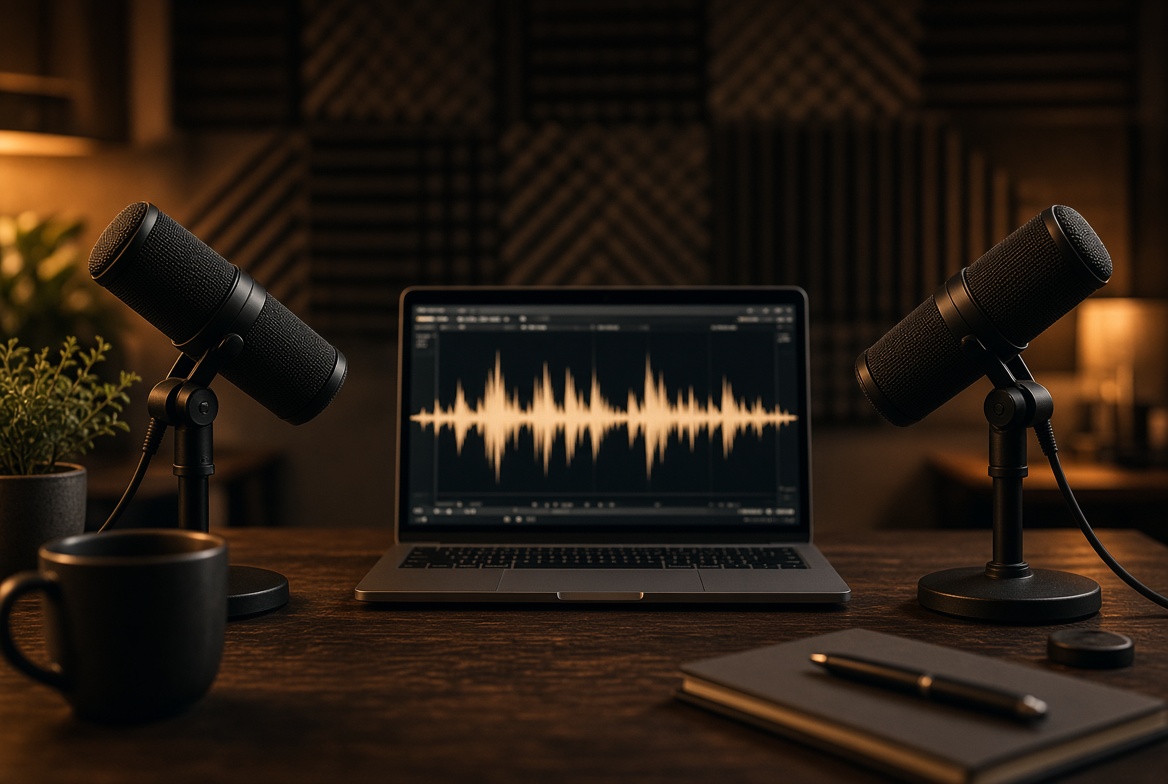
Global podcast listenership crossed 500 million monthly listeners in 2024 and kept climbing through 2026, and the competition for attention that comes with a growing medium has a specific, well-documented consequence: listeners have zero patience for a rough edit. Background noise, uneven levels, or too many "ums" now cost a show its audience almost immediately, in a field with over 5 million active podcasts fighting for the same attention.
According to Spotify for Creators' 2026 survey of over 1,100 podcast creators, one in four are already using AI tools somewhere in their production process — and creators with larger audiences are nearly twice as likely to have already adopted AI compared to those just starting out, a meaningful signal about where this is heading. Here's the actual pipeline, broken into the stages where a specific tool earns its place, rather than a pile of overlapping subscriptions.
Editing: Descript, and the paradigm shift that actually changed the math
Descript is described as "the gold standard" or "the king of AI-powered podcast editing" across essentially every independent 2026 comparison, and the reason is a genuine workflow change rather than an incremental feature: it transcribes your recording, and you edit by editing the text — delete a sentence in the transcript, and the corresponding audio disappears automatically. Traditional waveform editing means scrubbing through an hour of audio to cut a twenty-minute interview down to twelve; text-based editing turns that into something closer to editing a document.
That shift has a measured impact, not just a qualitative one: multiple 2026 industry analyses put the reduction in post-production time at 60-70% for creators who've adopted a text-based workflow. Studio Sound cleans up recording quality automatically, and its "regenerate" feature can fix a single flubbed line using AI voice matching, without requiring the host to re-record an entire segment over one stumble.
Voice and narration: ElevenLabs for anything beyond your own recorded voice
For intro narration, filling a gap where a guest's audio genuinely can't be salvaged, or producing consistent branded show elements, ElevenLabs remains the quality benchmark for AI voice generation — its free tier (10,000 credits monthly, roughly 10 minutes of speech) is enough to test whether a generated voice actually fits your show's tone before committing to anything paid.
Transcription specifically: the accessibility and SEO layer most shows skip
Roughly 70% of podcast creators now use AI-powered speech-to-text instead of manual transcription, according to 2026 tracking, and the reasons go beyond convenience: transcripts measurably improve organic search discoverability and can lift video engagement by up to 50% when podcasts distribute video versions with accompanying text. Beyond the SEO case, a published transcript makes an episode accessible to deaf and hard-of-hearing listeners and to anyone in a setting — a noisy commute, a quiet office — where audio simply isn't practical. Modern transcription tools hit 95%+ accuracy on clear English audio at under $0.10 per audio minute, which makes skipping this step a genuinely expensive shortcut for the audience reach it costs you.
Repurposing: turning one recording into a week of content
A single one-hour episode reliably contains dozens of quotable moments and at least three or four clips strong enough for Reels or Shorts, plus a blog post and social content — extracting all of that manually takes most of a workday. Dedicated repurposing tools automate finding and cutting those moments, which is exactly why 2026 industry guides describe this as the step where "repurposing stops being optional and starts being standard practice" rather than a nice-to-have a well-resourced show can afford and a solo creator can't.
The pipeline, stage by stage
| Stage | Tool | What it actually saves |
|---|---|---|
| Editing | Descript | 60-70% less post-production time |
| Voice/narration | ElevenLabs | Consistent intro/branding without a studio session |
| Transcription | Otter.ai or built into Descript | SEO reach + accessibility, up to 50% engagement lift |
| Clip extraction | Dedicated repurposing tool | A full workday of manual clipping per episode |
Match the tool to the actual job, not the longest feature list
One of the most repeated, practical pieces of advice across 2026 podcast tool guides: most teams waste money buying a full editing suite when what they actually need is automated cleanup, or pay for a repurposing platform when a simpler, free clipper would cover their volume. Before adding a tool, identify the specific stage of your current workflow that's genuinely costing you the most time — for most solo creators, that's editing — and start there rather than adopting the full stack at once.
For the voice and video-editing layers that overlap heavily with podcast production, our deeper comparisons of AI voice generators and AI video editors cover those categories in more depth.
Final thoughts
The gap that used to require a three-person production team — engineer, editor, social media manager — has genuinely closed for a solo podcaster willing to build the right small stack. Start with a text-based editor if editing is your bottleneck, add transcription for the SEO and accessibility reach it unlocks, and only add a dedicated repurposing tool once you're consistently publishing enough episodes that manual clipping is eating a full day each week. Bigger creators adopting AI at nearly twice the rate of newer ones isn't a coincidence — it's what happens once a workflow proves out.
Maya Chen is a creator strategist at ToolVerse AI, covering AI tools and the future of software. Maya has been writing about AI since 2022 and personally tests every tool covered in this guide.
- Hands-on AI tester
- Covers AI since 2022
- ToolVerse AI editorial team
Frequently asked questions
Our verdict on this audio guide
The ToolVerse AI editorial team evaluated every tool and claim in "Best AI Podcast Tools in 2026 (Recording to Growth)" against five criteria, with hands-on testing, source-checking and a quarterly accuracy review.
- Ease of useOnboarding flow, UX clarity and time-to-first-value.4.9
- Features & depthBreadth of capabilities vs. category benchmarks.4.7
- Pricing valueFree-tier generosity and price-to-output ratio.4.8
- PerformanceSpeed, reliability and output quality in real tests.4.3
- Support & docsHelp center, response times and community resources.4.7
How we evaluate AI tools
Every product on ToolVerse AI is independently tested by our editors. We sign up, complete the same real-world tasks across each tool in a category, document the experience, and compare against direct competitors. We don't accept payment for rankings, and affiliate relationships never influence editorial scores. Scores are reviewed quarterly to reflect new features, pricing changes and user feedback.
Related articles
Best AI Voice Generators Online in 2026
AI voices can now fool most humans with 3 seconds of sample audio — which makes choosing a responsible tool, not just a good-sounding one, part of the decision. Here's what to actually pick in 2026.
Best AI Video Editors in 2026: Descript vs CapCut vs Runway
We timed the same raw footage through three different AI video editors. Descript finished a full podcast-to-clips workflow in 28 minutes. CapCut was faster for vertical social cuts. Here's which one actually matches how you edit, not just which has the longest feature list.
10 AI Tools Every Content Creator Needs in 2026
91% of creators now use AI in their production process — but the ones actually growing aren't the ones using the most tools. Here's the AI content creation stack that holds up in 2026, and the trap most solo creators fall into.